The short version
- Instacart's ad auction is closed in a way Amazon's and Google's are not. You can't bid on a category unless your product is physically on the shelves the platform serves, so the room stays small and the clicks stay cheap.
- Around a quarter of US grocery sales now run through third-party delivery apps, and Instacart is the largest of them. Your product is already selling there whether or not anyone at your company is managing it.
- Placement decides almost everything. Instacart puts roughly 70% to 80% of platform sales in the first couple of rows a shopper sees, so ad position carries most of the sale on its own.
- The budget question is usually the wrong one. This spend has a legitimate claim on your trade and promotions budget, and unlike a demo you can read the result by SKU and by retailer.
- One honest caveat: Instacart ads don't build organic rank the way Amazon ads do, so ad contribution stays high and you can't taper spend the same way.
What's in here: how the auction works · why distribution is the barrier · what "first two rows" means for your budget · the retailer question nobody asks until it bites · where the money should come from · when it's worth doing at all
A brand we work with was in Costco and doing almost nothing on Instacart, and it wasn't because anyone had decided against it. Their team had looked at the account, seen a positive return coming off the automated setup, and moved on to something louder.
That account went on to grow 20x on Instacart sales. Trevor Hults at Tosí gave us his name and that number to use, and it's the cleanest example we have of the thing brands keep missing: on Instacart, the auction is closed to anyone without shelf space, which is why the clicks are still cheap for the brands that have it.
Your distribution is the barrier to entry on this channel, and you've already paid for it.
How is Instacart advertising different from Amazon or Google ads?
The difference is who's allowed to bid. On Amazon, you and I could invent a brand this afternoon, ship a pallet in, and start bidding on the same terms as a national label by Friday. On Google it's easier still, because nothing has to physically exist. Both auctions are open, and open auctions get crowded, which is what pushes cost per click up over time.
Instacart's auction is gated by physical retail. You can only advertise against a SKU sitting on the shelves of the retailers Instacart serves. A brand with no distribution can't buy its way into the room at any price. So the set of bidders in your category is roughly the set of brands already on the shelf next to you, and that's a much shorter list than the one competing for you on Amazon.
The practical result shows up in the numbers. Across the accounts we run, cost per click on Instacart sits below what the same brand pays on Amazon or Google for comparable intent, and it isn't because the traffic is worth less. The traffic is a grocery shopper filling a cart, so it's worth plenty. Fewer people are simply allowed to bid for it.
For a manufacturer with real retail distribution and a consumer line that's stalled online, this is the rare case where the thing that makes you slow, all that physical distribution you spent years building, is also the thing that makes a channel cheap for you and expensive for everyone else. If you've spent a decade getting onto those shelves, you earned an advantage here that no amount of ad budget can buy. That work was harder than anything we do, and it's worth saying so.
How much of grocery happens on Instacart?
Roughly a quarter of US grocery sales now go through third-party delivery apps, and Instacart is the largest single player among them. The category is getting more crowded at the edges as DoorDash and Uber Eats push further into grocery, but Instacart remains the one with the retailer relationships and the ad infrastructure built out.
The part that surprises brand teams is that this isn't a decision they get to make. If your product is stocked in an Instacart partner retailer, it's being sold on Instacart right now. There's a listing, there's a price, there are competitors appearing beside you, and there's an auction running whether or not anyone on your side is participating in it.
We were slow to take this seriously ourselves, so this isn't us scolding anyone. The question was never whether to be on Instacart, because you're on it already. The question is whether anyone is managing what happens there, and for most brands with good retail distribution the honest answer is no.
Why does ad placement matter so much on Instacart?
Instacart's own figure is that something like 70% to 80% of sales on the platform happen within the first couple of rows a shopper sees. A grocery shopper filling a weekly cart is not browsing to page four. They're scanning, tapping, and moving on to the next item on the list.
That concentration changes what advertising is for. On a channel where shoppers browse deeply, ads supplement organic discovery. On Instacart, position in those first rows is most of the sale, which is why a well-run account can see the large majority of its platform revenue coming through ads. On one specialty ingredient account we manage, ad-attributed sales run consistently above 80% of the total, and that isn't a sign of something broken.
Which brings up the caveat we'd rather give you now than have you discover in month three.
Instacart ads don't build organic rank the way Amazon ads do. On Amazon, sales velocity from paid placement feeds organic ranking, so a well-run account gradually earns traffic it stops paying for. Instacart doesn't work that way. The ad contribution stays high, and pulling spend back tends to pull sales back with it rather than revealing an organic base underneath. Anyone selling you Instacart as a channel you'll eventually stop paying for is either new to it or hoping you don't check.
Should Instacart ads come out of the marketing budget or the trade budget?
Trade, in most cases, and this is the single most useful reframe we can offer a brand that thinks it can't afford this channel.
Brands are starting to tell buyers that they'll skip a couple of in-store ad placements next year and put that money into retail media instead, and the response from buyers has been better than most brand teams expect. A broker we've worked with confirmed the same pattern from their side of the table, which matters more than us saying it, because they sit between the brand and the buyer and watch those conversations land.
The argument holds up because of what you can measure. A demo lifts velocity, and almost nobody can tell you afterwards which products it moved. Instacart spend can be sliced by SKU and by retailer, so you can see which products moved and where. For a brand that's been asked to justify trade spend with numbers it doesn't have, this is a line item that answers the question.
That distinction also matters for the size of the pot. A marketing budget at a mid-sized CPG brand is usually small and heavily spoken for. The trade and promotions budget is a different order of magnitude, and this spend has a legitimate claim on it.
Do my Instacart ads run at every retailer, or can I pick?
Your ads are placed against a SKU, so they surface wherever that SKU is stocked across Instacart's partner retailers. You don't get clean per-retailer control by default, and this catches brands out more often than any other mechanic on the platform.
There are two partial exceptions worth knowing. Some retailers, Sprouts among them, run separate sub-accounts, so promotions there can be isolated from the rest. And if you sell different pack sizes into different retailers, those count as different SKUs, which gives you a lever that looks like retailer targeting even though it's really pack architecture.
This turns into a commercial problem once a broker is involved. A broker contracted for the natural channel but not for Costco, Walmart or Target can end up driving sales into retailers they aren't compensated for, and there's no clean way to switch that off inside the platform. It's solvable in the contract. It just has to be solved before the campaigns run, not after the first month's report raises the question.
When is Instacart worth managing properly?
The qualifying number we use is retail doors. Below roughly 1,000 Instacart partner doors, the ceiling is usually too low to carry management fees and still leave the brand better off. Above about 2,000 doors, we've yet to see an account where careful management didn't move sales in a way the brand could feel.
Two other signals are worth checking before anyone spends anything:
- Costco distribution. Costco overperforms on Instacart relative to its share of a brand's physical sales, so a brand that's in Costco and running nothing on Instacart is usually sitting on the largest single gap in its account.
- A positive return on automated ads. This one is counterintuitive. If you switched Instacart ads on, left them automated, and they're returning a profit, leaving them alone is the expensive option, because being profitable on the platform's default settings with nobody steering is the clearest signal in the account that managed spend would return several times more.
If neither of those is true and your door count is low, the honest answer is that this channel can wait. We'd rather tell you that now than take a retainer for twelve months of managing something that was never going to carry it.
Frequently asked questions
How much does Instacart advertising cost?
The spend itself is flexible, and the more useful number is what a click costs relative to your other channels. Instacart clicks run below comparable Amazon and Google placements because the bidding pool is limited to brands with physical distribution. Management fees vary, but the threshold worth applying is whether the account has enough retail doors behind it to carry the cost, which for us starts around 1,000 partner doors and gets comfortable above 2,000.
Can I advertise on Instacart without being in stores?
No, and that restriction is what makes the channel worth your attention. Instacart advertising is tied to products stocked at its partner retailers, so a brand with no physical distribution can't participate. If you've spent years building retail placement, this is one of the few channels where that investment translates directly into cheaper media.
Does Instacart advertising help my organic ranking?
Not the way Amazon advertising does. On Amazon, paid sales velocity feeds organic rank, so a mature account earns traffic it no longer pays for. Instacart doesn't have that flywheel, so ad contribution stays high and spend can't be tapered on the assumption that organic will catch you. Plan the budget as an ongoing cost, not a launch investment.
Should Instacart spend come from trade or marketing?
Trade, usually. Brands are increasingly redirecting a portion of in-store promotional spend here, and buyers have responded well when the brand brings the numbers. The practical advantage over a demo is measurement: you can read results by SKU and by retailer instead of inferring a general lift.
We're already running automated Instacart ads and they're profitable. Do we need to change anything?
That's the account we most want to look at. Profitability on default automated settings, with nobody managing placements, bids or promotions, means the platform is doing the easy part and the rest is sitting there untouched. It's the strongest predictor we know of a large gain from active management.
What happens if my broker isn't contracted for all the retailers I'm in?
It needs sorting out in the agreement before campaigns launch. Instacart places ads against your SKU wherever it's stocked, so you can't confine the results to a subset of retailers without either separate sub-accounts where the retailer offers them or different pack sizes per channel. Brokers we've worked with have solved this with a commission structure that covers platform-driven sales across the board.
The bottom line
If your brand has real retail distribution and nobody is managing Instacart, you're leaving the cheapest media you have access to sitting unclaimed, and the shoppers are there either way. The auction is small because your competitors are limited to the brands beside you on the shelf, and that advantage doesn't last forever.
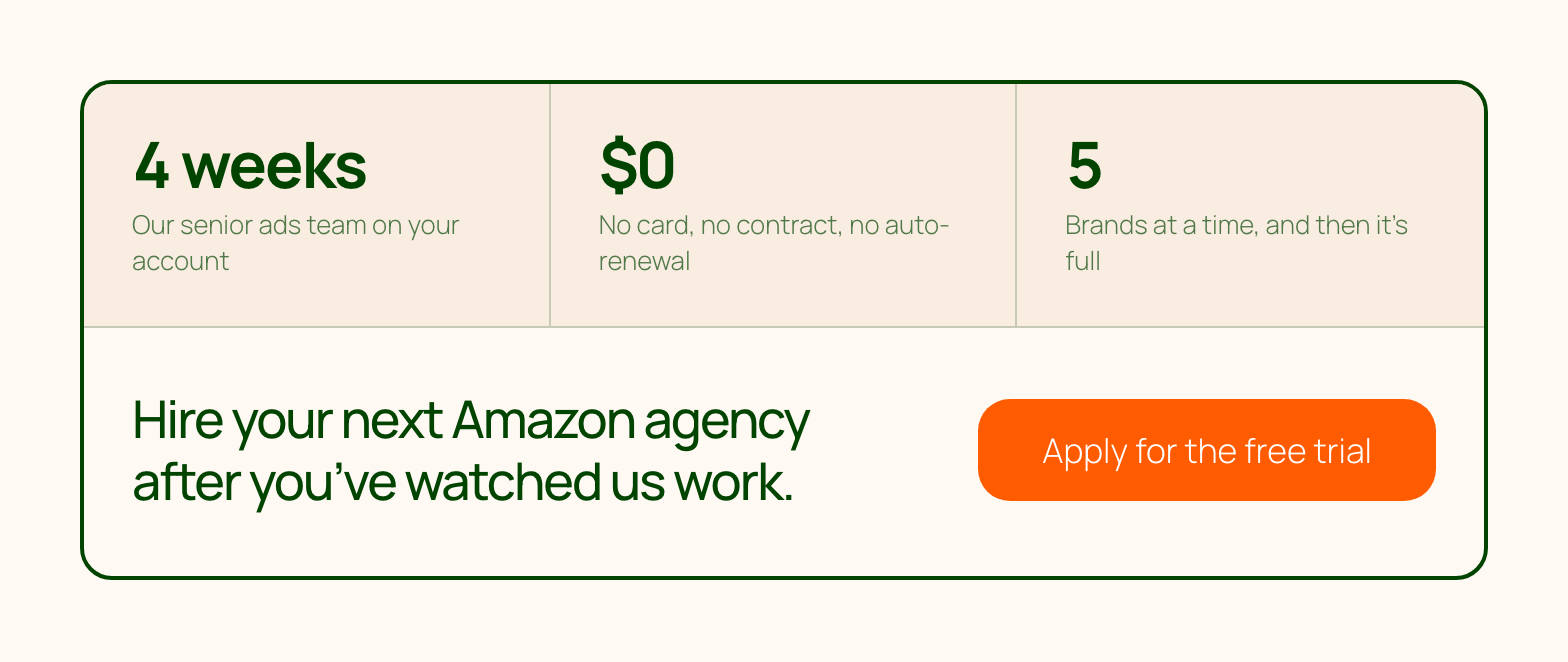
We'll take one of your accounts for 30 days at no cost and show you what the lift looks like, on the condition that we pick the account. If the numbers don't move, you've lost nothing and you'll know where this channel sits for your brand. If they do, you'll have the read you needed to make the budget argument internally.
You've built the distribution. It should be paying you twice.
.png)
.png)